Introduction
There’s something genuinely appealing about the idea of putting ingredients into a pot in the morning, walking away, and returning home to a fully prepared dinner. This simple concept has made slow cookers a staple in kitchens for decades. Yet, the slow cooker category has evolved significantly from its origins. Modern iterations now offer digital controls, specialized features, and capabilities that extend well beyond basic meal preparation.
The appeal of slow cookers in contemporary cooking isn’t difficult to understand. In a world where schedules feel increasingly packed and time feels like a precious commodity, the ability to prepare nutritious, complex meals with minimal active involvement addresses a genuine need. Beyond mere convenience, slow cooking itself is a method that transforms tough, affordable cuts of meat into tender, flavorful dishes through gentle, extended heat. It’s a cooking technique that actually improves food quality while simplifying the cook’s life.
Today’s slow cookers, particularly models equipped with digital programming, temperature monitoring, and enhanced portability features, represent a thoughtful evolution of this kitchen tool. These additions speak to how modern consumers actually cook—planning meals in advance, wanting precise control, and often needing to transport dishes to gatherings. This guide explores what makes contemporary programmable slow cookers valuable additions to a kitchen and examines the practical features that matter in daily use.
Understanding the Modern Slow Cooker Category
Before diving into the specifics of any individual model, it’s worth understanding what has changed in slow cooker design over the years. The original slow cookers were remarkably simple: a heating element, a ceramic pot, and perhaps one or two heat settings. Today’s versions operate on completely different principles regarding control and versatility.
The introduction of digital controls fundamentally changed how slow cookers function. Rather than relying on a cook’s experience and attention, digital programming allows for precise cooking durations and multiple temperature settings. This precision matters more than you might initially think. Different dishes require different combinations of time and temperature. Tougher cuts of meat might need eight hours on low heat, while vegetables often cook perfectly in four to six hours. The ability to program specific durations means dishes can finish at predictable times, and food doesn’t accidentally overcook.
Temperature monitoring represents another significant advancement. Traditional slow cookers cooked until they were done, which could vary considerably. Modern temperature probes allow for more sophisticated cooking, including the ability to transition between different heat levels automatically. This is particularly valuable for dishes that benefit from starting on high heat to develop flavors, then finishing on low heat to prevent drying out.
The consideration of portability has also influenced modern slow cooker design. Historically, slow cookers were stationary kitchen appliances. Contemporary life, however, often involves taking prepared food to potlucks, family gatherings, or picnics. This has led manufacturers to incorporate features like secure lid mechanisms that prevent spills during transport and stainless steel construction that looks appropriate beyond the kitchen.
Key Features Found in Contemporary Programmable Models
When examining what distinguishes modern slow cookers, several features consistently appear in well-designed models. Understanding what these features actually do in practice helps determine whether they align with how you cook.
Digital Programmability and Timing Control
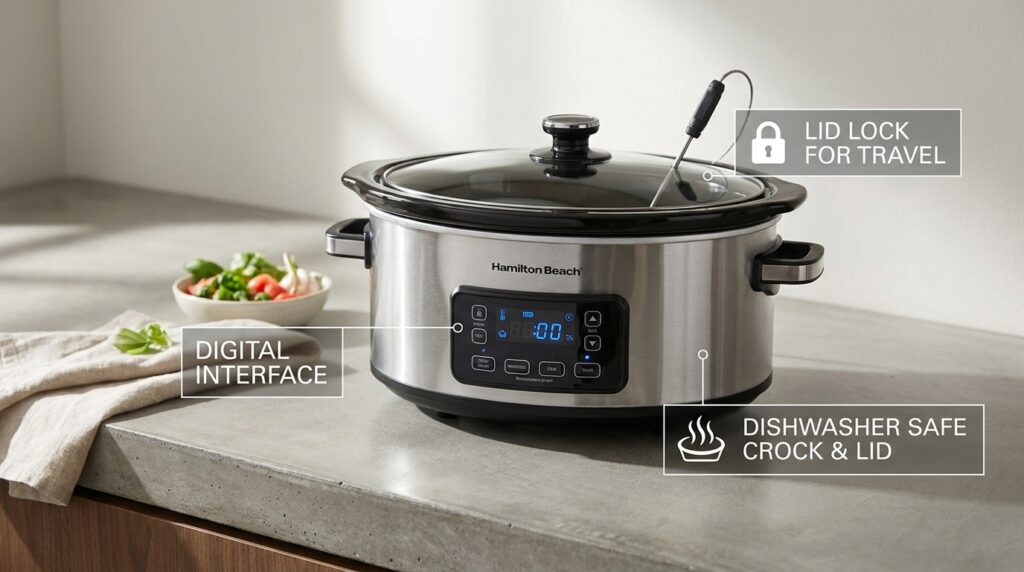
Digital controls transform the slow cooker from a set-it-and-forget-it tool into something with genuine flexibility. Rather than starting your slow cooker and hoping it finishes at dinner time, programming allows you to specify cooking duration with precision. This capability becomes particularly valuable when you’re managing a family schedule or planning meals around work commitments.
The mechanics of digital programming vary slightly between models, but the principle remains consistent. You input your desired cooking time and temperature, and the appliance manages the heat delivery to match those specifications. Some models extend this functionality by offering preset programs for common dishes—chili, stew, roasts, and soups. These presets remove guesswork and represent the manufacturer’s experience with optimal cooking times for various foods.
A practical benefit that often goes unmentioned is how programmability affects energy consumption. Once cooking completes, units can switch to a low-temperature warming mode, preventing overcooking while keeping food safe and ready whenever household members arrive home. This is distinctly different from older models that simply maintained heat throughout the day.
Temperature Monitoring With Probe Technology
The inclusion of a temperature probe represents a different category of control than simple timer programming. Rather than relying solely on elapsed time, this feature monitors the internal temperature of the food itself. This distinction matters significantly, particularly when cooking proteins.
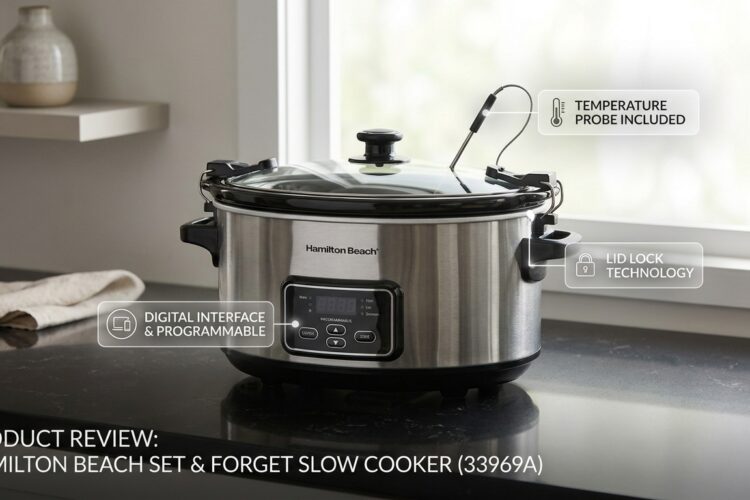
A temperature probe works by inserting into the thickest part of meat or other ingredients, providing real-time readings of internal temperature. Programmable models equipped with probes can be set to automatically switch from cooking to warming once the target temperature is reached. This prevents overcooked, dry meat—a common problem when relying solely on time estimates.
The application of this technology extends beyond simply preventing overcooking. It removes a source of uncertainty and anxiety from meal preparation. Many cooks worry about whether meat has reached food safety temperatures, particularly when using budget-friendly cuts. Temperature monitoring addresses this concern directly.
Secure Lid Mechanisms for Transport
An often-overlooked feature in slow cooker design is how the lid fastens. Traditional slow cookers simply rest a glass lid on top. While this works adequately at home, transporting a slow cooker full of hot liquid to a gathering presents obvious challenges. Spilled chili across the car floor transforms from hypothetical worst-case scenario to actual disaster.
Modern locking lid mechanisms address this directly. Rather than relying on gravity and hope, secure latches firmly hold the lid in place. This seemingly simple feature fundamentally changes where and how people use their slow cookers. Suddenly, preparing dishes at home and bringing them to community events, potlucks, or family gatherings becomes genuinely practical rather than an exercise in anxiety management.
Dishwasher-Safe Cooking Vessels
The ceramic crocks that hold food in slow cookers require regular washing, yet hand-washing adds cleanup time that partially negates the convenience benefit of slow cooking in the first place. Manufacturer attention to making crocks and lids dishwasher safe reflects an understanding of actual cooking practices.
This becomes particularly significant when you consider household rhythm. A busy evening involves finishing dinner, cleaning up, perhaps handling other household tasks, and finally preparing for the next day. The difference between hand-washing a large ceramic crock and simply placing it in a dishwasher might seem minimal but accumulates across multiple cooking sessions. Over a month, this represents genuinely meaningful time and effort reduction.
The additional consideration is safety and durability. Handwashing ceramic cookware presents risk of accidental breakage and requires careful handling. Dishwashers, while they involve mechanical action, operate within controlled parameters that ceramic is engineered to withstand.
Stainless Steel Construction
The exterior materials of slow cookers have evolved from basic plastic housings to stainless steel finishes. This shift reflects both aesthetic and practical considerations. Stainless steel construction provides several concrete benefits beyond appearance.
Durability represents the primary advantage. Stainless steel resists denting, scratching, and corrosion in ways that plastic or painted surfaces do not. This matters because slow cookers often spend years in regular use. A stainless steel exterior looks virtually identical after years of use, whereas plastic housings develop discoloration and scratches.
The aesthetic consideration shouldn’t be dismissed entirely, though it’s secondary to function. As slow cookers became more feature-rich and capable of sitting on counters longer, they evolved to look more like appliances people wanted visible rather than items to hide away. Stainless steel finish fits naturally into contemporary kitchen aesthetics alongside other countertop appliances.
Capacity Considerations
The 6-quart capacity represents a deliberate design choice reflecting how most households actually cook. Smaller 2 to 4-quart models suit cooking for individuals or couples but prove limiting when preparing food for families or gatherings. The 6-quart capacity strikes a balance—large enough to serve a family of six to eight comfortably, yet not so massive that it becomes difficult to store or manage.
Capacity intersects with practical cooking in several ways. A 6-quart slow cooker can simultaneously cook a roast with surrounding vegetables, providing a complete one-pot meal. This same capacity handles batch cooking, preparing multiple portions for freezing or multiple days of meals. For people hosting regular potlucks, having capacity to prepare substantial quantities provides flexibility.
Practical Applications and Everyday Uses
Understanding how slow cookers fit into real cooking practices differs meaningfully from simply understanding their features. The distinction matters because features only justify themselves through actual use.
Family Meal Preparation
The most common application involves preparing family dinners on days when time is limited. A cook might brown some meat the night before or during a brief morning window, combine it with vegetables and seasonings in the slow cooker before leaving for work, and return to a finished meal. This workflow requires minimal active cooking time while producing satisfying, nutritious meals.
The 6-quart capacity works particularly well for this purpose. A typical family dinner of pot roast, potatoes, and carrots fills the cooker reasonably full without cramming ingredients. The result feeds a family with minimal hassle while creating a comforting, substantial meal.
Batch Cooking and Meal Preparation
Many people adopt approaches to meal preparation that involve dedicating certain days to cooking multiple meals. Slow cookers prove exceptionally valuable for this purpose. A cook can prepare several batches of chili, soup, or stew across multiple cookers or through multiple cooking cycles, then portion and freeze everything. This upfront cooking investment reduces weeknight demands significantly.
The capacity to handle 6 quarts of finished product means that batch cooking sessions produce meaningful quantities. A single batch might yield eight to twelve individual meal portions, depending on serving size and how densely packed the ingredients are.
Entertaining and Potluck Contributions
Modern life often involves contributing prepared food to community events, family gatherings, or workplace potlucks. The combination of secure lid fastening and adequate capacity makes slow cookers particularly valuable for these situations. A cook can prepare a substantial quantity of a dish at home, secure it for transport, and have it maintain proper temperature throughout an event.
The digital programming feature supports entertaining by allowing a host to prepare dishes on a specific schedule that aligns with when guests arrive. Rather than guessing whether soup will be ready when people show up, programming ensures predictable timing.
Budget-Friendly Cooking With Quality Results
Slow cooking’s gentle heat and extended duration transform economical cuts of meat into delicious, tender results. This stands as perhaps the most significant practical advantage of slow cooking compared to other preparation methods. A less expensive cut of beef that would be tough and unsatisfying if roasted becomes genuinely excellent when slow cooked for eight hours.
This economics matter at household level. A family capable of preparing restaurant-quality meals using budget-friendly ingredients stretches food budgets considerably. Over weeks and months, this accumulates into meaningful financial impact for many households.
Customizable Recipe Development
The consistent, controllable heat of programmable slow cookers supports recipe experimentation. A cook might develop a signature chili, stew, or braise through repeated adjustments, confident that cooking times and temperatures will be consistent from one attempt to the next. This consistency supports learning and refinement in ways that variable cooking methods don’t.
The temperature probe feature particularly supports this, as it removes temperature-related variables from the equation. A cook can focus on flavors, ingredients, and texture while relying on the equipment to manage temperature precision.
Who Might Find This Category Valuable
Understanding which cooking situations and living circumstances make slow cookers genuinely useful involves honest assessment of actual usage patterns.
Full-Time Working Households
Families where adults spend significant hours away from home benefit substantially from slow cookers. The ability to prepare complete meals that are ready upon arrival home addresses a genuine challenge in household logistics. Rather than faced with the choice between convenient but less satisfying options and meals requiring active evening effort, slow cooking provides a third path.
Parents Managing Multiple Schedules
Many households with children face challenges around variable schedules and demanding evenings. Different children might have different activities on different evenings. Slow cookers allow preparation of meals that work on different timelines. A parent might know that dinner needs to be ready somewhere between five and seven in the evening, and programming allows for this flexibility.
People With Dietary Preferences or Restrictions
Slow cooking accommodates dietary customization readily. A vegetarian household can follow the same basic cooking approach as a meat-eating one, simply substituting vegetables or plant-based proteins. Similarly, people managing specific dietary needs for health reasons often find slow cooking supportive because it reduces reliance on processed convenience foods.
Home Cooks Seeking Flavor Development
Experienced cooks sometimes choose slow cooking specifically for how it develops flavors. The extended time at gentle heat allows seasonings to meld and develop complexity that faster cooking methods don’t achieve. For people interested in cooking quality as an end in itself rather than purely convenience, slow cookers offer genuine appeal.
People Who Entertain Regularly
Hosting gatherings is substantially easier when you can prepare food in advance and maintain it at serving temperature. The ability to transport prepared dishes securely also expands hosting possibilities. Someone might comfortably contribute to community events without stress about food safety or transport logistics.
Batch Cooks and Freezer Meal Preppers
People who dedicate certain days to preparing and freezing multiple meals find slow cookers exceptionally efficient. The ability to produce substantial quantities of finished food with minimal active cooking time aligns perfectly with this approach.
Important Practical Considerations Before Purchase
While slow cookers offer genuine advantages, certain practical considerations deserve honest assessment before committing to one.
Available Storage Space
A 6-quart slow cooker occupies meaningful countertop or cabinet space. Before acquiring one, considering where you’ll store it matters. Some people with limited kitchen space might find the footprint genuinely challenging. Alternatively, people with generous storage might view it as manageable or even keep it on the counter regularly.
Electricity Consumption
Slow cookers use electricity throughout their cooking cycle. While they’re generally efficient compared to ovens, someone focused on minimizing electricity consumption should factor this into their thinking. That said, the total energy usage over a cooking cycle is typically lower than using an oven for the same cooking time.
Learning Curve and Experimentation
While slow cookers are intuitive, developing genuine competence with them involves some learning. Early experiments might produce suboptimal results. Vegetables might be mushy, meat might be drier than expected, or seasonings might not develop as hoped. This learning phase is normal and temporary but deserves acknowledgment. People approaching slow cooking should view initial attempts as learning opportunities rather than failures.
Cooking Time Flexibility
Despite their convenience, slow cookers require advance planning. You can’t spontaneously decide to slow cook something for dinner without planning several hours ahead. People who prefer cooking flexibility might find this aspect limiting. However, others view advance planning as beneficial because it forces meal thought-through, preventing last-minute scrambling.
Food Safety Awareness
Slow cooking food safely involves understanding appropriate temperatures and cooking durations. Ground meat requires different approaches than whole cuts, frozen ingredients present different considerations than fresh ones, and dairy additions work better at specific points in cooking. Learning these basics is straightforward, but it represents a genuine requirement for food safety.
Flavor Development Variability
The flavors developed through slow cooking depend heavily on ingredients, seasonings, and cooking duration. Someone expecting slow cooking to automatically produce impressive results regardless of input might experience disappointment. Slow cookers are genuinely excellent at developing flavors, but technique still matters.
Comparison With General Slow Cooker Categories
The landscape of slow cookers includes models across a wide spectrum of complexity and price points. Understanding the general categories helps clarify what distinguishes modern programmable models with advanced features.
Basic Models With Fixed Settings
The simplest slow cookers include a heating element, a ceramic crock, and perhaps one or two heat settings controlled by simple dials. These models are affordable and perfectly functional for people simply interested in basic slow cooking. However, they offer no programmable timing and no temperature monitoring. A cook needs to estimate cooking time and manually turn off the unit when done.
Programmable Models With Basic Features
The next category adds digital controls that allow specification of cooking time and temperature. These are considerably more versatile than basic models, allowing precise cooking control and scheduled meal preparation. Most people find this level of functionality addresses their needs effectively.
Advanced Models With Temperature Monitoring and Multiple Features
The category at the upper end of the spectrum integrates temperature probes, secure locking lids, dishwasher-safe components, attractive exterior materials, and often preset programs for various dishes. These models represent a more complete solution for people who cook regularly with slow cookers and want to minimize variables and maximize convenience.
The distinctions between these categories aren’t merely about feature quantity. They reflect different philosophies about how slow cookers fit into household life. Someone viewing a slow cooker as an occasional tool for specific dishes might find a basic model perfectly adequate. Someone viewing it as a regular part of weekly cooking might find more advanced features genuinely valuable.
The price differences between categories reflect these feature additions but also represent different levels of build quality and durability. Models with more features and premium materials often include more robust heating systems, better insulation, and components engineered for extended use.
Frequently Asked Questions About Modern Programmable Slow Cookers
How Does a Temperature Probe Improve Cooking Results?
A temperature probe monitors the internal temperature of food rather than relying solely on elapsed time. This matters because cooking time varies based on factors like ingredient quantity, starting temperature, and how densely packed the slow cooker is. By automatically detecting when food reaches target temperature, the probe prevents both undercooking and overcooking. This is particularly valuable for meat dishes where proper temperature ensures both safety and optimal texture.
What’s the Actual Difference Between “High” and “Low” Settings?
The distinction between high and low settings is one of temperature control. The low setting maintains a lower, gentler heat that works well for tough cuts of meat requiring extended cooking time to break down connective tissue. The high setting maintains higher temperature, cooking food more quickly. The choice between them depends on available time and what you’re cooking.
Can You Cook Frozen Ingredients in a Slow Cooker?
This question deserves nuance. You can cook some frozen ingredients, but it requires understanding safety considerations. Whole frozen vegetables work reasonably well, though they introduce water as they thaw and cook. Ground meat and chicken present different considerations. For safety, many experts recommend thawing meat before slow cooking to ensure it reaches proper temperature throughout. When in doubt, consult food safety resources rather than guessing.
How Do You Know When Food is Actually Done?
This depends on what you’re cooking. For vegetables, you’re looking for fork-tender texture. For meat, you’re primarily concerned with reaching safe internal temperature, which varies by meat type. Large whole cuts of beef might reach 160-175°F depending on preference. Poultry requires reaching 165°F throughout. Temperature probes remove guesswork by monitoring this directly. For recipes without specific internal temperature targets, checking texture and appearance remains the standard approach.
What’s the Difference Between “Cooking” and “Warming”?
Cooking mode applies heat to transform raw ingredients into finished food. Warming mode maintains lower temperature, keeping already-cooked food hot without further cooking it. Many modern programmable models automatically transition from cooking to warming once the programmed cooking duration completes. This prevents food from becoming overcooked while keeping it safe and ready to eat whenever needed.
How Much Prep Work Is Actually Required?
This varies tremendously depending on your recipe and preferences. Some slow cooker meals require simply dumping ingredients and setting the timer—essentially zero active cooking time. Others benefit from preliminary steps like browning meat to develop flavor or sautéing onions and garlic. The amount of prep is flexible and entirely within your control based on how much effort you want to invest.
Are Slow Cookers Actually Energy Efficient?
Compared to ovens, slow cookers are genuinely more efficient. An oven heating to high temperature and maintaining that heat for hours consumes considerably more electricity than a slow cooker maintaining low-to-medium heat for extended periods. However, slow cookers do consume electricity throughout their cooking cycle, sometimes for six to eight hours. For someone focused on minimizing electricity consumption, this merits consideration, though the total usage remains relatively modest.
Can You Leave a Slow Cooker Unattended for Eight Hours?
Yes, safely and with appropriate food. Slow cookers are specifically designed to cook without supervision. Once you’ve set the timer and closed the lid, you can leave home for work, errands, or other activities. The unit manages cooking automatically. The caveat is that you should trust the equipment—opening the lid frequently and checking progress actually extends cooking time and disrupts the process.
What Happens if You Add Ingredients Partway Through Cooking?
You can add ingredients partway through, but it affects cooking dynamics. Dense vegetables added near the end won’t cook as thoroughly as those added at the beginning. Dairy products or cream-based ingredients work better added in the final fifteen to thirty minutes to prevent curdling. Learning these specifics comes through experience and is part of the normal learning curve with slow cooking.
How Does Capacity Affect What You Can Cook?
A 6-quart capacity handles most family cooking scenarios effectively. It’s large enough to cook a whole roast with vegetables for six to eight people, or substantial quantities of soup or chili for batch cooking. It’s also not so large that it becomes difficult to store or use for smaller meals. Some recipes naturally fill the cooker more densely than others, and this affects cooking dynamics. Generally, a 6-quart capacity offers good flexibility for various household sizes and cooking situations.
Conclusion: Modern Slow Cooking as a Practical Strategy
Modern programmable slow cookers with advanced features represent genuine evolution in a decades-old cooking tool. The additions of digital controls, temperature monitoring, secure transport mechanisms, and premium materials reflect how people actually cook today—with planning constraints, desire for reliable results, and need for versatility.
Whether such features align with your cooking style ultimately depends on your specific situation. Someone cooking occasionally might find basic models perfectly sufficient. Someone cooking regularly who wants maximum control, reliability, and convenience might find advanced features genuinely valuable.
What hasn’t changed despite all the modernization is the fundamental appeal of slow cooking. The ability to develop complex, satisfying meals with minimal active cooking effort remains as attractive today as when slow cookers first appeared. The gentle heat still transforms humble ingredients into something delicious. The extended cooking time still builds flavor and tenderness in ways faster methods don’t achieve.
For people managing busy schedules, interested in batch cooking, entertaining regularly, or simply wanting to improve their food’s quality while reducing cooking effort, slow cookers remain worthy additions to a kitchen. The modern versions with digital control simply remove uncertainty and expand where and how you can use them.